Monday, February 22, 2016

Riding within your aids

I've lived a fairly clean life for the past 43 years.  I'm not a smoker.  I don't drink to excess.  I am not a binge eater.  I don't have what others would call an "addiction" problem.  I am horse crazy, and always have been, but that's different, right?  Unfortunately after 43 years of being clean and sober, I have to admit, finally, that I am addicted.  My name is Jenni Grimmett, and I am addicted to soft feel.

My addiction didn't start out to be that bad, as I was just beginning to learn the basics.  It's nice, after all, to have your horse do what you ask him to do without a fight or attitude or copious amounts of rein or spur.  That's neat and kind of fun.  I was sold on the whole idea of having a compliant mount. My first real "hit" of pure soft feel came the very first time that Eitan allowed me a glorious ride on Santa Fe Renegade.  Once I got over just being star struck with the gorgeous stallion and paid attention to what was happening underneath me I was thunderstruck by the depth of the lightness as well as true self carriage, which is, of course, a product of lightness.  

The next spring Dan and I traveled to our first Cowboy Dressage school and spent a week learning from Eitan.  That week I felt the first glimpses of true lightness and soft feel in my own horse.  That's when I became completely hooked.  Now, I want it so bad and am so consumed with it's pursuit that I will often wake in the middle of the night trying to recreate my past ride and relive those moments of lightness. Or, what will keep me up even longer is after those rides lacking in soft feel, rehashing where I went wrong and why things weren't working for me and the horse that day.
The more I learn about soft feel and the more hours I spend ruminating on exactly what it is, the more I am convinced that true lightness happens not when the horse responds to your aids, but when the horse responds to the air between you and your aids. In other words, the horse learns to respond to not just your cues but the intention of your cues.  When you and your horse are riding "skeleton to skeleton", your horse's body can mimic the positioning and energy of your own body.  Eitan has shared countless beautifully colored illustrations that help to drive home this point. 

 Your hips and lower legs cue the horse's hips and hind legs.  Your upper body,  including head, hands and shoulders, direct the horse's front legs, shoulders, neck and head.  The energy in your core, spine and hips drive the energy in your horse's hips which drives the energy in the gait.  The final piece of the puzzle in cuing the horse for soft feel by correct use of your body is timing.  Knowing foot falls and the timing of the gait allows you to more directly communicate with your horse's skeleton with accuracy and softness. 

You can use too much leg or spur creating a horse that is dull to that pressure, or you can ride with timing and energy in your seat instead of driving with your legs and keep the horse light and responsive and willing to go forward.  You can use too much hand and reins to the point that you create not only dullness but resistance in the horse, or you can direct the horse in bend using your upper body and lightness in the reins to keep the horse happy and soft in the head and neck.  Even when a rider has been struggling with position for years, creating confusion in the horse, the moment it is finally corrected the horse seems to say, "Oh! Well, why didn't you say so?"  There is no "re-educating" that needs to happen or rehabbing from the inadvertent misuse of your skeletal aids.  It is more like the horse is just waiting for you to do it correctly.  

On the bit, on the aid
Self carriage, riding within the aid
Many riders talk about the horse being on your aids.  Modern dressage riders talk about having the horse "on the bit".  I believe in Cowboy Dressage our goal is to have the horse completely off our aids.  When the horse is riding within the bubble created by our aids he is holding himself up without our help and building true self carriage. 


The more horses that I jump on and ride the more I come to realize almost all of them are looking for that soft feel.   We, as riders, often teach our horses not to look for soft feel by the overuse of aids.  Horses being good, quiet and compliant creatures often learn to deal with our overuse of aids by  ignoring them because we just won't stop pushing on them.  When I jump on a horse that the rider is having to thump with a pair of spurs every other stride and start driving with my seat instead of my legs they very quickly figure out to follow my lead and before you know it he is willingly moving forward in time with my seat without the need for driving with the legs.  It is my belief that horses are born addicted to soft feel too.  They just get so used to not having it there that they learn to live without it.  Once you reintroduce it to their system they are generally more than happy to follow along.  

Re-educating your skeleton to be your main aid is a very difficult thing to do for many riders.  Many of you may have physical limitations or aches and pains causing your to not have full, even use of your skeleton.  Do not despair!  With consistent riding your horse will learn to compensate for any cues you have to give a little differently due to such infirmities.  Soft feel, I promise you, is still within your reach.  

One of the most helpful things for riders, and one of my main jobs as a Cowboy Dressage educator is to help people correct those subtle imbalances or inadvertent miscommunication between their horse and their skeleton.  The two most common problems that I see in riders is 1, little to no use of the weight as an aid and 2, incorrect positioning of the legs and seat for bend. 

I wonder if in the english world the riders are maybe a bit better about their weight aids.  I think as Western riders we have a tendency to use our seat for one thing and one thing only.  Stopping.  Most folks that have been riding in some western discipline, know that if you want to stop you drop your weight down on the horse.
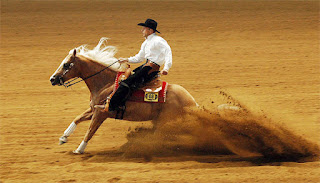
The folks in the reining discipline are so good at it that you can see them drop that weight down from the stands.  They'll rock back so far on their pockets that it looks like they are slumped in an easy chair.  It comes as a surprise to many riders that they can ride the horse forward with their seat.  Having an active seat and riding with your horse, stride for stride, is the first step towards building communication between your two skeletons.  When the horse understands you're not just sitting up there pushing him around with your legs and pulling him around with your hands but riding each and every stride, suddenly your seat takes on a whole new meaning.  As western riders I think we tend to sit too still in our saddles.  Those Western saddles with big cushy padded seats often stirrup fenders that limit the riders leg movement are meant to keep the rider in one steady position rather than moving along with horse.

But even in our big western saddles, the horse can and does feel your seat and can respond to changes in the way you weight your seat so that he learns to move and bend with changes in the way you position your skeleton.  Understanding how the horse's skeleton moves through a bend helps us to understand how our skeleton also needs to move through a bend.  Our shoulders mimic the horses shoulders and guide them through the bend and our hips mimics the horse's hips and helps drive them forward evenly through the bend.


One of the things I love most about the swishy armitas that I ride in is the big long fringe that moves with me when I move.  When my horse and I really get a good free walk going on there is fringe a-swishing all over the place.  It's like jingle bobs or rein chains that are helping me to exaggerate that tempo of the walk.  You need to move to really ride your horse with each stride.  Loosen your hips, relax your legs and soften your shoulders and let your body move with your horse.  If the bubble within your aids is a nice soft place to be, your horse is going to be happy to meet you there.


Monday, January 11, 2016

Muscles of Balance


The muscles of the balanced horse provide a well defined
shape from head to tail.
In the discussion of maintaining and developing ideal physical form in the horse I’ve decided to remove the dreaded “C” word that seems to set nerve endings jangling in equestrian circles.  I believe if we can agree to discuss the horse as a general athlete, able to correctly perform a number of athletic and advanced maneuvers as well as maintain sustainable form to function, we can maybe agree to use a more general term.  I would like to, therefore, discuss balance in the equine frame.


The horse evolved for one purpose on the plains of this earth.  He evolved to survive.  He became fleet of foot with a long neck that was able to get to the often sparse grasses on the plains.  The eyes were large and set wide apart to allow for greater vision while in the grazing position.  The skeletal frame was designed to effortlessly carry the horse across miles and miles of ground without tiring in the pursuit of food, water, shelter and safety.  To that end the basic equine frame is one in which the top line is level.  In grazing stance or periods of rest the center of gravity shifts forward and in movement in a level frame shifts more towards midline to even the distribution and concussion of the forelimbs.  Forelimb performance lameness as we know them in the domestic horse including, navicular, laminitis, pastern arthrosis (ringbone) and arthritis are largely unknown in the wild horse population despite the 15-20 miles the average wild horse travels in a day.

Now, we have to be careful in comparing our domestic horse to the wild horse in all but form to function because we are making demands on our horses that are completely unnatural.  Sure, a horse in the wild is capable of performing Levades, piaffe, canter pirouettes, sliding stops and lofty extended trots.  They do not however, perform them with a large weight in the middle of their spinal column, nor do they sustain those movements for long periods of time.  Most of us in decent physical health could perform a burpee.  How many of us could perform 10 of them in a row without extreme fatigue?  In my circle of friends probably only a handful.  Now do that with a young child riding on your back.  Yeah, not near so easy.  It takes conditioning and muscle strength and suppling in order to correctly perform athletic maneuvers without causing undue stress, strain and wear and tear on normal joints.

Think about what lies below your saddle as you ride
So, our goal as we ride and condition our horses in the hopes of developing a sound, athletic body is to create balance and suppleness through the entire frame.  Like any good athletic coach will tell you this starts with a good working knowledge of how the body is put together. 
Let’s begin our discussion by looking at the frame work.

The equine spinal column is composed of three arcs.  Unlike the human skeleton which is designed to carry weight in a mostly upright position on a bipedal frame, the equine skeleton obviously distributes the weight fairly evenly along the spinal column to distribute weight along all 4 feet.  As we have already discussed in a grazing position, that balance shifts to carrying the weight more on the front feet, but in times of athletic movement that weight shifts back to the business end of the horse allowing for rapid acceleration and quicker turns. 

The three arches in the equine skeleton are:
1:  The 7 cervical vertebrae running from the head to the chest.  
2. The 18 thoracic and 6 lumbar vertebrae running from the withers to the loin.
3. The 5 fused sacral and caudal vertebrae running from the loin to the tip of the tail. 

In an athletic stance we would like for all three of these arches to be evenly engaged, effectively rounding out the entire horse.  In neutral the arches form one long low arch.  It is interesting and instructive to note that the lateral mobility of the equine spine is largely limited to the first and last arch.  The lateral movement through the thoracic vertebrae is limited at best and the loin and fused sacral vertebrae allow for virtually no lateral movement at all.  The only direction the lumbar-sacral joint is able to make is vertically allowing for coiling of the pelvis and flexion of the hip.  Because the lumbosacral joint has dorsal/ventral flexion of only 6.5 degrees, the majority of the flexion in the back of the horse occurs with flexion of the hip.


Not only are we attempting to develop a frame on the horse capable of athletic movement, we also must build the muscles responsible for carrying our weight without causing injury or excessive wear and tear on the horse's frame as well.  When the horse is first mounted he will drop his back away from the weight of the saddle and the rider, as one could expect.  The horse does this by extending his spine, contracting the long muscle of topline called the longisimus dorsi.  This is also the longest muscle in the horse's body and runs from the transverse processes of the last 4 cervical vertebrae along the transverse processes of the thoracic vertebrae and inserts on the dorsal processes of the lumbar vertebrae.  This causes the reverse arch through the thoracic vertebrae under the saddle and generally flattening of the first and third arch as well.  Stiffening of this long muscle due to fatigue or pain impairs the ability of the horse to round underneath the saddle.  Obviously that’s not ideal and as riders it’s our job to help the horse learn to deal with the weight and build the muscles that will allow it to carry the weight in a balanced frame. 

There is only one way to do this correctly.  And if you examine the muscles off the horse’s body in relation to the design of the equine frame it becomes obvious how training methods can get in our way and build the wrong muscles in our horses that effectively impair balance and form to function in young horses that carries through their entire lives. 

The muscles that are responsible or initiating coiling of the loins and the beginnings of balance through the topline are the hip flexors.  They are the muscles responsible for the thrust that drives the equine body forward.  When these muscles contract the lower the croup and loin loading the hip for the thrusting phase of the movement.  This spring like action carries forward into the 2nd and 1st arch like loading a spring.   When the hindquarters are not brought into play first and you attempt to create arch through the horse’s body by compressing or flexing just the head and neck, this drives the neck down into the thorax, flattens the back and pushes the hindquarters out behind the horse.

There are several ways to help your horse begin to develop the muscles that flex the hips.  Hills, going both up and down work these muscles efficiently.  Backing your horse, as long as he is stepping correctly in a trot back also develop the muscles of the hip flexors.  Lateral movements such as shoulder in, haunches in and leg yield also cause the horse to work the muscles of the hip flexors.  Any movement that asks the horse to step deeper underneath himself while still maintaining propulsion will improve the strength and flexibility of these flexor muscles. 


The muscles that are responsible for flexing the hip and coiling the loin may not be the muscles you think of when you look at the back of your horse.  The western horse is prized for big beefy hip muscles that extend well beyond the point of the him creating that luscious J-Lo look.  Those are the semimembranosus and semitendinosus muscles and they are responsible for extension of the limb and help to propel the horse forward in the stride. These are the very muscles that helped give the American Quarter Horse his name as they are responsible for quick burst of speed that is generated by these powerful thrusting muscles.  
The muscles of flexion are deep and hard to see. 
They are not, however the muscles that coil and flex the hip.  The hip flexors live deeper and include the Psoas major and minor, tensor fascia latae, gluteus superficialis.  These muscles work in opposition to the large semi m and semi t muscles on the back of the leg.  In fact, suppleness through those muscles is as important as strength in the flexor muscles when allowing the horse to coil the loins.  Some even suggest that the long muscles of the hip are equivalent to a second top line that allows the horse to stretch forward and step underneath himself allowing the balance of the horse to shift further back towards the loin.
 
The second arch of the spine is the thoracic vertebrae and loin.  We wish to develop muscles that lie below the transverse processes of the vertebrae rather than above them.  So while we, as horse owners spend a lot of time talking about developing a horse’s top line, it is not building the muscles of the top line as much as making sure those muscles remain soft, supple and flexible.    While we need good muscle tone along the top of the back for strength when carrying weight, these are not the muscles that are most effective in creating arch and loading the spring of the spine.   If you have ever seen a sway backed horse that is also in good flesh you will note that the dorsal processes (bony projections at the top of the spine) are not very evident.  This is because a sway back is not due to lack of muscles along the top of the spine.  Contraction of muscles dorsal to the transverse processes causes the spine to hollow.  Horses that are worked in this hollowed frame (park horses, harness horses, and often gaited horses) will have well developed muscle tone along the upper spine and poor muscle tone below the spine.  In order to cause the spine to round up and load the arch we need to work the muscles that lie below the transverse processes.  These muscles are involved not only in elevation of the spine but in lateral movements as well.  This is why lateral movements through the rib cage help to build strength and suppling in the muscles responsible for rounding of the spine.   BEND is the key to lateral strengthening as well as balancing and rounding the mid-section of the horse through loading of the muscles below the spine.  We need all of the muscles working together to strengthen and balance the horse.

The muscle groups responsible for lifting and rounding the back are smaller than the muscle that extends the back.  Like in the 3rd arch it is important for the muscles of opposition to remain supple and loose in order for the smaller muscles flexing the spine to act.  These muscles include the rectus abdominus, iliospoas complex and longus coli scalenus.

Rectus abdominus is a large thin muscle that lies along the abdominal wall and slings the abdominal contents like a hammock.  It attaches originates at the 4th, 5th and 9th rib and inserts at the pubis by means of a large tendon.  This muscle acts to arch the back largely by flexion at the lumbosacral joint.  Therefore, when engaging the abdominal muscles, you aren’t lifting the back so much as flexing the loin that then acts on the vertebrae of the back to arch slightly. 

If you look at the horse's body as if it's a suspension bridge you can see how the 1st and 3rd arch in the spine will anchor the span of 2nd arch.  The muscles of the abdomen and back below the vertebrae help lift the back into the securing arches of the neck and loin.  If either the arch in the neck or the arch in the loin are lost, the roundness in the back will drop as well.  It takes each piece of the horse's body working together to maximize the potential in each body part.  The whole horse will be stronger if each of the body parts is doing it's job and working in harmony.  Think of the tail end of the horse as the end of the bridge that has all of the supplies for building the rest of the bridge.  First you start there, then you create a base on the other side and then you bring the two sides together.  

Now, I left the first arch in the horse’s body for last for two reasons.  First of all it’s the last part of the puzzle in creating balance.  The greatest part the head and neck play in the overall balance is in shifting the weight of the horse backwards, towards the second and third arch allowing for the center of gravity to shift more towards the hindquarters freeing the forequarters for lofty movement and lessening the concussion on the front feet and legs.  Too often people start to balance a horse by worrying about the “head set” before worrying about engaging the horse. 

Bulging at the 3rd vertebrae due to
enlarged rectus capitus muscle
In order for the horse to correctly soften and arch the neck from spine to head he must first lift the base of the neck where it meets the withers.  As these vertebrae lift you can see the engagement off the muscles just to the front of the withers and just in front of the saddle.  This sets the horse up for proper head and neck carriage.  If you attempt to create an arch through neck by only flexing the poll this compresses the vertebrae and causes bracing at the 3rd and 4th vertebrae.  


Again, the horse is bracing and breaking
at the 3rd vertebrae
A properly engaged head and neck should be larger in at the base of the neck than at the mid thoracic vertebrae.  It is easy to tell if you horse has been developing the wrong neck muscles because he will bulge behind the poll.  Think of the head and neck as lifting from the chest and extending upwards and downwards.  Some suggest it’s the action a horse makes when he is looking into a bucket.  The must first lift then stretch then give at the poll.  This makes giving at the poll the very last action in the engagement of the muscles of balance and softening of the horse from tail to head. 


So, what are the take home messages for the rider that has little interest in anatomy but lots of interest in riding her horse? Here they are.
IF your horse is using the right muscles you can see it in their entire body if you know where to look. 

Does your horse have a bulging hind end with hard muscles when viewed from behind? He may be spending a lot of time in extension or thrusting those hind legs forward from behind the stifle.  You want those muscles to remain soft and supple and LONG to encourage the horse to step underneath himself as much as his conformation will allow.


This horse's back is hollow due to over developement
 of the longisimuss dorsi
Does your horse have a taught ropey back? Again, this is another muscle that we want long and soft with even fill along the entire back.  If your horse spends a lot of time in the hollowed dropped back stance the longisimuss dorsi will pull the spine back away from the shoulders and create that deep pocket.  It’s worse in horses with long laid back shoulders that are built to carry themselves hollowed out (Morgans, arabs, Saddlebreds, etc.) When the horse learns to lift and round his back this muscle will soften and quit tensing.  You should be able to softly palpate the muscles of the back from the spine to the top of the ribs.
This horse shortens and drops his neck, causing a ewe
neck and over developement of the trapezius muscle


Does your horse have a dip right in front of the saddle? This is caused by collapsing of the cervical vertebrae and over development of the trapezius.  When the horse pulls the neck back towards the withers this muscle tightens and thickens.  A chronic head tosser will have a well developed shortened muscle here.  We want to see the horse’s neck lift up in front of the saddle when engaged not dip down.


What about the muscles at the base of the neck?  Those should also be loose and stretchy allowing for the telescoping of the neck.  Thickening or tightening of these muscles shortens the cervical spine and creates a ewe necked appearance.  The muscles at the top of the neck that are responsible for stretch and lateral flexion are the only muscles that should be enlarging in the properly worked and balanced horse.  Those muscles should be toned and even from the poll to the withers. 
If the poll is flexed or braced without proper engagement of the remainder of the neck you get thickening of the rectus capitus.  This becomes the widest part of the horse's neck, and is especially noticeable when viewed from the saddle.

The well developed and balanced horse will have even muscle development through his entire upper body with soft supple stretchy muscles along the topline.  Obviously not every horse needs to be an elite athlete, just like not every rider is an elite athlete, but knowing which muscles are the "wrong" muscles  and which are the "right" muscles for balance may help us spot trouble areas in our riding and keep our horses sound and healthy well into their later years!


Tuesday, November 10, 2015

Cowboy Dressage Final Gathering 2015: Here's what you missed.

If you weren't at the Murieta Equestrian Center, in Ranch Murieta, California last week for the Cowboy Dressage Final Gathering, I hope you at least took advantage of the live streaming, because history was made.  Cowboy Dressage has been at the forefront of a revolution in equine competitions and equestrian lifestyle and this weekend we made a giant step forward in showing the world what is possible when you focus on riding with softness, lightness and partnership with your equine companion.

As always the gathering was populated with wonderful people and horses that had traveled from all corners of the world.  There were riders representing states including, California, Washington, Oregon, Idaho, Montana, Colorado, Texas, Oklahoma, Kansas, and probably a few others that I missed.  The Canadians were very well represented and I'm sure will have a time at the border crossing explaining all the "loot" they are taking home!  Great Britain, Poland, Germany and Australia were also represented.  It truly was a gathering of the Cowboy Dressage World.  It didn't matter where you hailed from because Cowboy Dressage looks the same no matter where you go.  It always looks soft.

All kinds of horses were represented as well.  Morgans were there in high numbers, but so were Quarter horses, Appaloosas, Paints, Arabians, Ponies, Saddlebreds, Mustangs, Fjords, Haflingers, Tennessee Walkers, Pasos, Rocky Mountain Horses, and others I'm sure I missed.

Riders of all ages were competing.  In the Silver (over 60) age group, the competition was fierce, and the youth riders were battling it out in their division as well.  Cowboy Dressage truly is for every horse and every rider interested in cultivating kindness and soft feel.

The 28 Top Hand Competitors 
The big history making event at this year's final gathering though, was the Top Hand competition.  This was the first year for this elite competition for Cowboy Dressage's top competitors to all throw their hats into the same ring.  Each rider rode the same test, W/J/L 2.  This test on the surface doesn't look terribly difficult.  It requires many of the standard maneuvers that many of our CD tests ask for.  The killer maneuver in this test is what we call the "bow tie".  This asks for the horse to lope half of a 20 m circle then change direction over the ground poles on the short diagonal with a lead change through the jog within the box (8-a-gon) then another half of a 20 m circle holding that lead through the box and then transitioning to a working jog.  It sounds easy enough until you try to ride it.  Out of the 28 horses and riders that ended up competing in the Top Hand, probably only a handful managed their two trips through the bow tie without a bauble.  That one maneuver requires such timing, softness and precision to execute perfectly that it really separates the cream from the milk.

After watching the first round of the competition most of us were trying to figure out who would make the top 10.  It was a difficult task.  Since virtually no one had been completely perfect it would come down to who had the most perfect ride and how heavily the judges penalized the different maneuvers.  It's also supposed to come down to soft feel and partnership, but I would have to say that for the most part, that element was universal as all of the riders exhibited with soft feel and partnership, even those that had come that were new to Cowboy Dressage.

Megan Gallager
When the top 10 finalists were announced, we were still in the dark trying to guess who the top five final competitors would be.  Cowboy Dressage World kept us all on the edge of our seats waiting until right before the moment they were going to have to ride onto that court to see who the top five were.  Once they were announced, then a Calcutta was offered and each rider was auctioned off to the highest bidder.  As each rider was being bid on they did their best to put on a show of their best horsemanship and the training that their horses had attained.  A couple of the riders removed bridles, did sliding stops, spins, lead changes, all in front of the screaming audience while, I'm sure, trying to go over the test they are about to ride in their heads.
Richard Winters

It was at that moment, watching the top 5 folks out in the ring that I realized how very far I still have to go.  There was not a doubt in my mind that any one of those talented riders and obedient, soft, willing horses had what it took to be the Top Hand.  All 5 of those teams were calm, cool, collected and rode like they had ice in their veins.  I was sweating and fidgeting in the stands for them as I watched my friends get ready to ride.  It was impossible to know who to root for so we rooted for them all.
Rebecca Worth 

Each of the riders had amazing rides on their horses in their next test, which was a brand new test to all of us.  This test again, had all of the elements we've all ridden before but in different order with shorter quicker transitions than we had seen before.  Those quick transitions, when riding with soft feel and lightness can be difficult to execute with precision, and it was completely gratifying to see them all do it well.  The field was pretty much wide open after the first go and then the real fun began as they drew to swap horses.

Jenni Purcell
The final 5 horses were as different as can be as a group.  There was a Paint, a Morgan, and three Quarter horses who were all different types of quarter horses.  The competitors had 2 minutes to ride their new mount, at a walk before the testing began.  Then right before their test they had another 2 minutes before their bell rang and they rode into the court.

You could have heard a pin drop in that arena.  We collectively held our breath as each rider rode in.  Then as they transitioned to the lope you could see cowboy hats bobbing in time as we all rode each stride with them.  The long test seemed to take forever and the stress was palpable, keeping us rooted to our seats watching each rider's go.

When the dust settled and it was all said and done, it came down to who had the best go on the horse that they drew.  Our Top Hand rider, Megan Gallagher had an amazing ride on both her Morgan and the beautiful Quarter Horse that belonged to Richard Winters.  Megan exhibits everything that the Top Hand rider should.  She is a kind, wonderful lady and an excellent horsewoman.  Her ride on Richard's horse was soft, quiet, and gorgeous.  She is what we are all striving to be.  Any one of those top 5 riders could have been the top hand, honestly.  The differences in scores between them all were minute, I'm sure, as were the points between all the top hand riders.
Marcia Moore Harrison

When we first dreamed up the Top Hand competition this is exactly what we were hoping for.  It was a stunning exhibition in soft feel and partnership and it brought in folks from far and wide that had never shown Cowboy Dressage before.

So, where does Cowboy Dressage World go from here?  This was our 3rd Final Gathering and we had 980 rides.  Cowboy Dressage continues to grow and bring in new members of our Cowboy Dressage Handshake family.  We now have an E-learning program in place that can reach an even larger audience for people that are struggling to build a Cowboy Dressage community in their area.  We are progressing towards establishing a regional gathering circuit as we build events in more and more areas.  New next year will also be a combined clinician and judges training course so that more and more judges are available for the growing number of events and clinicians trained to teach to the Cowboy Dressage World standards.

Cowboy Dressage is here to stay.  This isn't a fad.  This is a revolution in how people and horses in the western community communicate with each other and their horses and it is world wide.  What started with dreams of just one man and one horse has now spread to encompass the entire world.

Monday, October 19, 2015

Cowboy Dressage Arena Exercises

When I was in 3rd grade I started learning how to play the violin.  In my very first week of violin lessons we learned the basic scales.  Then for the next 5 years that I actively played the violin we started each lesson by warming up with the scales.  That elementary exercise was just as important when we were playing Ode to Joy as it was when we were playing Twinkle Twinkle Little Star.

There are some basic elementary exercises that I use in Cowboy Dressage that are the same as that scale for the violin player.  Each time I practice with my horse I start with some combination of these basic exercises before moving onto more advanced maneuvers.  They serve to get the muscles warmed up evenly, help to establish communication between horse and rider and check the horse's balance and movement before the day's work begins.  

1. Partnership on the Ground.  For my horses, I always start with just a little bit of Partnership on the Ground.  It may be just a few driving circles where I change the bend a few times, or it may be running through the entire Partnership on the Ground Test 1.  I've found that it helps me to sync my energy to the horse's energy before I even put my foot in the stirrup.  It allows the horse to tell me before I get on if something is bothering him.  Sometimes this part of my day will take 3 minutes, sometimes it takes 20 minutes.  It varies depending on my goals for the day, my time schedule (unfortunately) and the horse.  But you should always start your day and your partnership on the ground.  It really improves the quality of partnership you will receive from your horse when you step into the saddle.  I don't do groundwork because my horses aren't "broke enough" for me to just step on.  I do groundwork because my horses are broke enough that it matters where our heads are at in the game.  When partnership and soft feel are your goal, you'd be crazy to forgo anything that would enhance that partnership when you step into the saddle.

2.  Free Walk.  I always start with at least a lap of free walk.  Again, this for me is about syncing my energy to the horse.  It allows the horse and I to establish a cadence, a feel for what the energy is between us that day and for the horse to loosen up and get settled to his environment.  With my colts, it gives them a chance to check the arena for boogie men before I start asking for more concentration and effort with more difficult maneuvers.  I tend to sing, whistle, yodel, bee-bop, anything to help my horses just settle into the day's exercises ahead of us.  Having music on in the arena is a plus!! 

3. One handed 10 m Figure 8.  If we have our challenge court set up I like to do this exercise with my 10 m circles at H and M so I can utilize the poles and cones.  If I'm on the regular court I like to do this exercise at 8 with my circles at B and E.  It doesn't matter a whit where you do it, I suppose,  as long as your goal is to soften and shorten your horse laterally one side at a time.   Establish bend on your horse by shortening just the inside rein to a 10 m bend and then dropping your hand to the withers. There should be no pressure on the outside rein for this exercise.  Create the bend with your body with your inside leg at the front cinch and your outside leg back towards the flank.  Ride the bend forward.  When you complete one circle, change hands and rein, change your hips/legs and ride the bend forward in the other 10 m circle.  For young/green horses I like to really help them through the change of bend by riding straight for 2-3 strides before shifting my aids to the other circle.  This creates more of a double D shape than a figure 8.

There are many wonderful things that happen during this exercise when you do it properly.  First of all you soften the horse laterally and warm up those muscles.  This is an excellent exercise for introducing or working on soft feel because you are working just one rein at a time.  The goal of this exercise is not to hold the horse in bend but to ask the horse to hold himself in bend within your aids.  If your horse is hanging on your hand or you feel any rein pressure at all, put some life in that rein and ask that horse to look for the soft feel.  When he comes off that rein pressure make sure your hand is quiet and not pulling on him.  That is his release.  In this exercise the rein does not establish direction, it only establishes bend.  Your seat and legs help the horse create the circle that you have started by asking for bend with the rein.  If the horse falls to the inside of the circle, get your inside leg active.  If the horse drifts out of the circle, get your outside leg active.  If the horse is following your soft feel and staying on the circle make sure your aids are soft and quiet to reward him.   The energy and cadence of the walk is established by your seat.  Resist the urge to push your horse along with your legs or bump him forward with every stride.  If you need more energy and your horse isn't listening to your seat, ask with both legs once with purpose, don't nag!  Get in and get out and return to riding quietly so the horse seeks the quiet soft spot between your aids.

4. Big Circle, Little Circle:  This is a variation of the one handed figure 8.  After the horse has established good soft quality bend in the figure 8, I like to firmly establish body control with my seat and leg aids by shrinking the circle to about 5 m.  After riding a quality 10 m circle to the right, when I come back to the center I will shrink that circle in to 5 m with my outside leg then take the horse back to the 10 m circle with my inside leg.    

5.  Long Diagonals: There are several things I work on in this exercise.  Gait quality, transitions, 10 m bend and soft feel in the working gait and rein management for the rider.  You can do this exercise at both the walk and the jog.  Let's start at K in the free walk.  Get a good quality free walk with energy, lengthening of the stride and stretching of the top line.  Before you reach M, begin to pick up just your inside rein.  At M apply inside leg and still your energy for the transition to the 10 m bend.  Outside leg helps keep the horse from drifting too deep in the corner.  Hold the bend to Y then pick up the outside rein to ask the horse to go straight to Q in the working walk.  At Q lengthen the outside rein, hold the inside rein through the 10 m bend then lengthen rein to the long frame in the free walk at H.  Repeat when you get to F.  If you struggle with rein management and lengthening and shortening your reins without snatching at them this exercise will help you to think about the lengthening and shortening in more of a step wise fashion.  It's also great for horses that are bothered when asked to hold soft feel in the working frame for a long period of time.  That short 10 m is just enough to ask them to hold it with softness before they get bothered. 

6. B/E 20m and 10 m nested circles.  This particular exercise probably has as much to do with my geldings current state of mind as all of the other exercises put together.  My horse was a terrible rusher in the free jog.  Working with nested circles is an excellent tool for those horses that tend to get up a head of steam in the free jog rather than relaxing and stretching like they are supposed to! This is also the exercise that I personally find the most useful when preparing my horse for lope transitions.  Begin with a 10 m circle at either the working walk or working jog at either B or E.  Then step directly into the 20 m circle in the free jog.  Remember to maintain bend.  Don't do too much steering and LET THE HORSE GO.  If the horse speeds up and begins to get too fast, worried, or bothered, sit, quit posting, pick up the inside rein (with soft feel, don't snatch!) and ask for a 10 m circle in a working jog.  Wait for the horse to come back to a quality working jog and then return to the free jog like nothing happened.  For the really rushy or worried horses I find doing a 10 m circle at not only B and E but I and D helps to keep the horse from getting too fast too quickly. 

To be successful at this exercise you have to learn to prepare the horse for the transitions from free jog to working jog.  If you wait until your stirrup is already at the marker you will be too late, pull the rein too hard and yank the horse into an unbalanced 10 m circle.  Instead, sit a stride or two before the marker, breathe out, shorten the inside rein while applying inside leg and at the marker apply outside leg to ask the horse to enter the bend.  

Once you are successful and the horse is transitioning with from free jog to working jog with soft feel going one direction, change direction through 8 changing bend in the working jog and repeat the exercise going the other direction.

Remember that the key to lightness and soft feel is the release.  In the words of the great Jack Brainard, "Thou shalt not dwell with either leg or rein." If you feel like you are hanging onto your horse, kicking your horse or pushing your horse into frame think about your aids.  Are you maybe doing too much?  Most riders are.  Try doing less and ask your horse to meet you in the middle.

There are many many more exercises that you can do using the Cowboy Dressage court, but these few basic exercises are part of our everyday warm up routine.  Your horse is never too broke or too advanced to forgo a visit back to the fundamentals! Don't forget your scales before your concerto!


Sunday, October 11, 2015

It's Time

Tomorrow I have to mail out my entry forms for the final Cowboy Dressage Gathering of the year.  We all tend to call it "finals" but it's really just the last show of the season.  In Cowboy Dressage you don't have to qualify to show at "finals".  It's not a gathering of only the best of us.  It's more of a family reunion.  It's the time of year that we can all get together, celebrate our triumphs for the year and share our goals in horsemanship for the year to come.

This year there is added excitement to the final Gathering as it is the first year for the much publicized and promoted "Top Hand" competition.  This is meant to be a calling to arms of sorts for the folks out there that have been walking the walk and talking the talk.  Let's put you all in the same arena, with the same test and the same judges and see how the scores shake out.  It's a time to be honoring those among us that are truly embracing and showcasing what Cowboy Dressage is all about.

Which is not competition.

You see, it's a double edged sword.  In the Cowboy Dressage community we truly are a welcoming, come one come all group of horse folk.  I know you've heard that before, but really and truly, this is the place for anybody who seeks a better relationship with their horse.  We will all tell you again and again it is not about the competition.  And it's not.  Really.

But, sometimes it takes the crucible of competition to push those that are striving for the absolute best to reach just a bit higher.  Early on in the year I decided that my horse and I just weren't quite Top Hand material.  We had made enormous strides in softness and partnership, but in my opinion, I still had so far to go, that the Top Hand competition seemed out of reach.

I told myself I would see how my summer show season went, see how we stacked up and then decide.  So, that's what I did.  I had one phenomenal show, where I felt my partnership and soft feel with my horse were better than ever and then I had one where my soft feel and partnership left the building.

It was after the second show that I decided this wasn't the year.  So I gave my horse essentially a month off while I worked my colt and thought maybe I could take him to finals in place of my older gelding who can't always keep it together in the show ring.  That way the question of should I or should I not enter Top Hand was firmly and safely out of my head; clearing the way for unobstructed and pure horsemanship, or so I thought.

Maybe it's just me, but if I don't have a specific goal I am working towards, I tend to drift a bit.  I had worked very hard in the months before my summer shows getting my gelding ready.  But when I decided to forgo both Top Hand and taking him to the Final Gathering my direction got muddled.  I didn't have the same goals with my colt, thinking I would just do Partnership on the Ground and a few easy W/J classes at the final Gathering.

Suddenly it's the end of September and the time for really choosing who and what I would be showcasing at the Final Gathering was upon us.  Time to make a decision.  I decided to just try the test for Top Hand and see where I was.  No harm there, right?  I had purposely NOT been even looking at or reading the qualifying test for Top Hand all summer thinking that it wasn't our year and would just distract us from our goals. What I found is that I wasn't as far off as I thought I was.  So, that planted the seed that maybe, just maybe, I should be working on this Top Hand thing.

So, the past few weeks I have been training and working harder than I have all summer.  I have been concentrating on soft feel and working on partnership and accuracy in an attempt to prepare my horse for the competition that I had decided that I wasn't ready for.

Here is what I have learned from that experience:

1.  Because it's Cowboy Dressage and Soft Feel and Partnership are always at the forefront, you CANNOT take short cuts.  You maybe able to ride the test, but until you can ride the test with softness, bend, cadence, accuracy AND partnership you aren't ready.

2. I am 100% goal oriented. Without a concrete goal and benchmark, I am adrift in my horsemanship.  I know this isn't true for everybody but thank goodness for the competition side of Cowboy Dressage.  If I had to just get good at 10 m bend for the sake of being good at 10 m bend without somebody somewhere saying just how good I am at 10 m bend I don't know if I would ever get as good at it as I can.  When there is no finish line, good enough becomes good enough.

3.  I am my own worse critic.  So many times I end a ride disappointed and frustrated only to have my friends say, "wow, he looked great!".  Sometimes you have to reward the good to get to the great.

4.   Most of us will never attain greatness without somebody else pushing us to get there.  Competition does this for us.

So while Cowboy Dressage is not at all about the competition, competition is how I personally will someday (I hope!) attain greatness.   I have worked harder these past few weeks than I did all summer.  It's not that I am striving for a goal or a prize so much as I am striving to be worthy of even riding along side the folks riding for that prize.  That is the magic of the competitive venue.

The unique part about Cowboy Dressage and what sets it apart from all the other forms of equine competition is that folks that have not established soft feel and partnership will not fare well in the competition.  Like any good interpersonal relationship, trust, partnership and harmony take time and patience.  It's going to be a real treat to watch the Top Hand Competition this year.  It should be a showcase of softness.  Will we be in the running?  I guess you better come and watch to find out!


Tuesday, September 29, 2015

Cowboy Dressage on the Beach

Northwest Saddle Sisters


Ask any horse owner what their one dream place to ride their horse is and you will likely get the same answer.  Within every single equestrian I've ever met is the dream and desire to ride your horse splashing through the ocean waves.  The ocean is romantic, mesmerizing, constant and yet ever changing.  For a group of in-landers like us it was a siren song. 

For our annual Cowboy Dressage Cowgirl retreat this year we chose an ocean side destination. Ocean Acres, in Grayland, Washington is a unique place that caters to horse people infected with the crazy desire to gallop in the waves.   Though only one of the horses in our group had seen the ocean before, many of the horses were very well seasoned trail horses that have crossed rivers, swam in lakes and have experienced all the vast changes in terrain and footing that the western mountains can provide.  Most of us were confident that our horses would have little problem adjusting to a little sand and waves.


We couldn't have been more wrong. 

The beach is at once both the most perfect place to ride and the most challenging place to ride.  Had we not had the experience and wisdom of our clinician, Dale Rumens-Partee, I am convinced I would be writing to tell you all about the group of us charging headlong across the sand towards the water on our seasoned trail mounts only to wind up being dumped quickly in the romantically crashing waves.

So, for those of you who dream of galloping through the ocean waves, but may not have the benefit of either seasoned horses or an experienced guide, let me at least forewarn you of the pitfalls of rushing out onto the beach without properly exposing your horse to the environment.
Our fearless leader, Dale Rumens-Partee and her lovely saddlebred, Buc


First of all, there is a lot of space.  That alone can really unsettle some horses, especially those horses that spend their lives in the trees and mountains like many of ours do.  While some horses won't be bothered the shear amount of horizon to keep your eye on can put some horses on their guard.  The best way to help your horse deal with all that space is to keep them focused on a small part of it.  So, our group did a lot of circles, serpentines, and figure 8's helping our horses to retain their focus on a small chunk of real estate in front of them.  I so wanted to just stop and stare at all that open space as soon as we reached the edge of the beach, and so did Chico, but I could feel him getting a little worried about it.  As soon as he had a job to focus on the worry and extra energy left his body and he was able to relax. 

Sand is a weird footing.  It is constantly shifting and moving, blowing, clumping, sucking and changing.  The dry sand is difficult for the horses to walk in and until they are used to it can be very hard on their tendons.  If they see something that worries them and feel the need to move quickly they can get bogged down in that deep sand and step all over themselves.  So, the best tactic is to again, keep them moving forward in a controlled manner.  The deep sand is excellent for working on bend and softening them laterally.  They already want to shorten their stride to deal with the deep sand, so shortening them laterally naturally bends them around your inside leg.  Far more than any other place I've ridden you really do need to ride every step of the way on the beach.  As you move closer to the water the dry sand turns into wet sand providing better footing, but it's a different feel for the horses.  Quite a few of the horses in our group were bothered by the way the sand changes colors when you step on it.  Then when you do work your way into the waves, the sand gets pulled out from under their feet. 

The waves both make noise and move, which is the magic combination to induce the flight response in horses.  Luckily, they also retreat.  As the waves are drawing out, that is the ideal time to ask your horse to follow them.  If you can get your timing right you can follow the waves out and then step into the back of the wave so your horse is walking suddenly in the shallow surf.  Beware the wave coming on the heels of the first, though.  That crashing white wall of surf looks solid to the horse and they will bolt out of it to dry land in a hurry.  If one of your buddies is standing there, it becomes a fun game of bumper horses. When riding in a group it's important to keep an open exit strategy.  The horse blowing sideways out of the wave won't be looking at the horse he's running over, he's focused on the wave trying to touch his feet. Constantly asking your horse to check back in with you is a test of any good partnership.  If you can keep your horse feeling back to you, it will strengthen your partnership and your horse's trust in you.  Of course, that's if you keep him out of trouble!  Don't jeopardize your partnership by scaring your horse into the water.  Don't expose him to more than he can handle at one time.
Me and my Morgan horse, Chico

Another challenging thing about the ocean is that it can cause motion sickness if you are standing in the waves and watching them.  It's an odd enough sensation for a person, but it happens to the horse as well.  If the horse spends too much time standing still or watching the waves he may become disoriented. For most horses that will result in him going over backwards.  Always keep forward movement when in the waves.

So, if the waves sound like too much of a challenge, and you would rather stay on the sand, there are still plenty of things to keep you on your toes.  If it's low tide, there are often puddles of water on what looks like mostly level beach.  Some of these can be deceivingly deep.  Approach these with caution.  The kelp beds at the high tide line can also be a challenge.  I don't know if it's the smell or the feel of that kelp but it bothers quite a few of the horses.  The long tentacles of seaweed can be a challenge both in the water and on the shore.  Those can whip around a horse's leg and suddenly you have a horse caught in a long dragging scary monster rope.  Then there is the detritus of old pallets with nails in them hidden under the sand, driftwood, dead birds, sharks, fish, crabs, etc. 

If you are on a section of beach that is used by other folks, not on horseback, you will find a number of other challenges.  Kites are wonderful fun for horses.  They swoop and dive and whoosh and if you get too close, can suddenly hit the ground next to your horse.  The savvy horseman watches the kites, makes a judgement on the length of that kite string and stays a reasonable distance away from them.  Loose dogs, kids, motorbikes, etc are all reasonable challenges that most horses have encountered outside of the beach but when coupled with the other challenges mentioned above add an extra dimension.
This pack of kites was right along side the area we set up our first Cowboy Dressage court. I was standing at P when I took this picture. 
 
If you're reaching for a white out pen to edit your Equine Bucket List, reach no further.  Being aware of the pitfalls is the first step.  Like any other challenge for your horse, you can help your horse deal with the chaos in a constructive manner.  Keeping your horse focused and engaged helps you redirect any excess energy.  That deep sand is great for getting them sucking wind in a hurry (just be careful of those tendons!).  And once you have experienced the joy of jogging and trotting figures on miles and miles of perfect beach you will realize that the real fun of riding at the beach isn't the romantic gallop through the waves, it's the abundance of perfect footing for schooling your horse and redirecting his energy back to you and therefore strengthening your partnership and harmony with each figure 8, circle, serpentine and straight line that you do. 
Establishing our center line in the sand

When you find a section of pristine beach with perfect footing it's the perfect time to make use of that area for riding with accuracy.  You can quickly sketch out a Cowboy Dressage court and it's fun to establish the track and long and short diagonals to help really visualize the court geometry, especially if you are still struggling with learning that. We packed a few lengths of string with us to set up the court.  Two 10m strings and one 5m string allowed us to quickly outline the boundary of our court. Then we rode around the track of the court in single file to get a good solid line in the sand.  We also rode the long and short diagonals and the quarter lines.  This helped us to establish some straightness and was instrumental in teaching the basic pattern of the court to those of the girls that were new to it. From there we moved to riding circles until the sand got too deep and we moved on to a clean chunk of beach.
Our first court, standing at A and looking towards C

Even if you do not set up a court, you have your tracks in the sand to hold you accountable.  Riding out on a circle and then trying to keep to that circle with bend in all that open space is a challenge for horse and rider.  All that sand is also a wonderful place to work on straight lines.  You may feel like you are riding straight but those tracks in the sand don't lie.  That one spot you thought your horse maybe looked to the right you may see your tracks take a big bobble to the left.  Keeping the horse centered beneath you is even more challenging with all the distractions the beach can provide.  And if you have been having trouble with any of the lateral movements like shoulder in, haunches in leg yields and have pass, and have been trying to visualize the "tracks" we talk about with those maneuvers, that sand makes it easy to see.  You can look back over your tracks in the sand and see right were they went from two tracks, to three tracks to four tracks.   I feel like I got more accomplished in preparing and training my horse for the Cowboy Dressage Final Gathering in November this past weekend on the beach than I did the entire month of August on our court at home.

Those of you lucky enough to live near a beach, I hope you take advantage of that amazing footing and great partnership building as often as you can.  The Northwest Saddle Sisters are already planning our next trip back.


Monday, August 10, 2015

The Culture of Cowboy Dressage


One of things that continues to impress folks that are brand new to Cowboy Dressage and the Gatherings is the culture they encounter at these events. We hear over and over again, "I've never experienced anything like this!"

Every equine discipline has it’s unique feel.  A barrel race isn’t going to feel anything like a dressage show and an open horse show feels much different than a regional breed show.  Cowboy Dressage has it’s own very different feel and environment and the one thing that each person new to Cowboy Dressage will tell you after their first event is that it is universally welcoming.

There is a feeling of calmness, ease and quiet at a Cowboy Dressage Gathering.  It feels like family, even if you are brand new because everybody is so anxious to warmly welcome you into the family.  From the Gathering secretaries to the grounds men to each and every participant you find smiling helpful faces. 

Is it an act?  Horse people, especially horse show people, aren’t generally known for being overly friendly.  Are all these people just putting on a friendly face?  Not in the least.  Cowboy Dressage is built on the premise of kindness.  Kindness to horses.  Kindness to each other.  Softness and lightness and joy suffuse the environment at a Cowboy Dressage Gathering. 

Besides the happy and welcoming environment created by the people, newcomers will also be surprised that there isn’t a “look” to a Gathering.  You will find all manner of horses, people, tack, and attire.  Each person feels free to embrace whatever “Cowboy” means to them.  Never has such an eclectic bunch ever mingled in one arena! You’ll see some of the more common western show attires from folks coming from the Western Pleasure world.  You’ll see youth riders in their favorite (and probably only ;) ) button up shirt.  You’ll see wild rags, bolo ties, neckerchiefs, bow ties, or regular ties.  You’ll see reining saddles, trail saddles, show saddles, roping saddles and barrel saddles.  You’ll see snaffles, bosals, two handed western bits and spades. You'll see jeans, riding skirts, chaps, chinks and armitas.  As long as it's "cowboy" it'll fly! 

Because Cowboy Dressage welcomes one and all there is no “look” that you can point your finger to and say, that looks like a Cowboy Dressage rider or horse;  with one very distinct exception.

Each and every person looks happy, excited to be there and excitedly nervous, but not overly pressured.  This is a low key environment from the regional shows to our “Final Gathering”.  The horses are happy and quiet and obedient.  The warm up pen is a friendly gathering of friends riding together.  The judges are warm and welcoming and encouraging.  Please, thank you and you’re welcome ring out in the arena. If you make a mistake during your test, you can stop and the judge will help you find your spot so you can start over.  At the last Gathering I was complimenting a lady on her nice soft ride.  She had also lost her way during her test, had to go back and start over from the last letter missed.  She was flustered and upset about it and I told her (and so did the judge) that it just didn't matter.  She came up to me later with her 2nd place ribbon absolutely thrilled.  She couldn't believe she could mess up, restart her test and still score second in the class.  When soft feel and partnership and gaits are more important than individual maneuvers, you bet you can! 

Another distinct difference is that many of these horses that come to do Cowboy Dressage have another job that they do.  Their other job may be as show horses in another discipline, but most of them are also trail horses, lesson horses, ranch horses or pleasure horses.  It makes for happier horses overall.  You don’t see horses at Cowboy Dressage Gatherings that pull back, rear, buck, kick, or act out.  In general, the worst behavior problems we deal with in Cowboy Dressage is separating buddy horses, but because in Cowboy Dressage we are all about the horse, this simply isn’t an issue.  Every rider is allowed a horse or two if needed to accompany a nervous horse into the arena.  The environment is kept quiet and peaceful for the horses and for the people.

As a veterinarian, horse shows can be a very busy environment to be a part of.  I’ll admit to keeping my presence as quiet as possible at open shows when I am there to show my own horse.  I can’t tell you how many times I’ve almost been late to enter my own class because somebody’s horse threw a tantrum in the trailer/stall/cross ties and needs to be sutured up so they don’t miss their class.  The end of the show was always a busy time as well as folks struggled to load unwilling horses and called on me and my drugs to help them.


Of course, horses are horses and anything can happen at any time, but the quiet, calm environment that we create for horse and rider at Cowboy Dressage Gatherings, means these incidents are exceedingly rare.   

The Cowboy Dressage culture is one of "come one, come all".  We want you to be a part of the revolution taking place in horsemanship.  There is room for everybody interested in softness, partnership, and harmony.  Even if you never plan to show, there is a group of people out there waiting for someone just like you to come and join the ride.  So, saddle up!  C'mon, we've got places to go, horses to ride, and people to meet!